
1. THE HEART AND HEAD LINES
感情线与智慧线
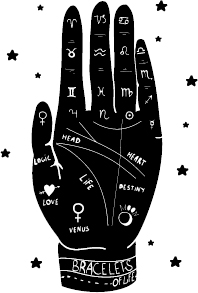
The areas and lines of the hand offer information on the age-old issues that prompt all divinatory searching: love, success, health, family, money, and happiness.
意译: 手掌的区域与纹理揭示了那些由来已久的问题,正是这些问题驱使着人们进行各种占卜探索:爱情、成功、健康、家庭、金钱以及幸福。
直译: 手的区域和线条提供了关于古老问题的信息,这些问题促使了所有占卜的探索:爱情、成功、健康、家庭、金钱和幸福。
Two of the most important and easily identifiable lines on the handlines that reflect our past, present, and future lives and choices—are the line of the Heart and the line of the Head.
意译: 在反映我们过去、现在和未来生活与选择的掌纹中,最重要且最易辨认的两条线便是感情线和智慧线。
直译: 手纹上最重要且最容易辨认的两条线——它们反映了我们过去、现在和未来的生活与选择——是感情线和头脑线。
You will already have felt the energies of these two lines as you ran your fingers close to these lines, the highest horizontal lines that generally extend across the palms of both hands.
意译: 当你的手指划过这两条线附近时——它们通常是横跨双手的最高处的横线——想必你已经感受到了它们的能量。
直译: 当你将手指靠近这两条线,即通常横跨双手手掌的最高水平线时,你将已经感受到了这两条线的能量。
You may have sensed blockages or sudden surges of energy at certain points along these lines.
意译: 沿着这些脉络,你可能在某些特定位置感觉到了能量的淤堵或突然涌动。
直译: 你可能已经感觉到了能量的堵塞或突然涌动,在沿着这些线的某些点上。
The Heart line, the upper one, is read left to right across the palm in the Active hand.
意译: 在看主动手(惯用手)时,感情线(即上面那条线)要从左向右横穿手掌来看。
直译: 感情线,即上面那一条,在主动手上是从左到右穿过手掌被解读的。
The Head line is read right to left across the palm in the Active hand.
意译: 在惯用手上,智慧线需从右向左横跨手掌进行解读。
直译: 智慧线在主动手上是被从右向左横跨手掌阅读的。
With the Inactive hand, the Heart line is read right to left and the Head line is read left to right across the palm.
意译: 对于非惯用手而言,感情线的解读方向是从右到左,而智慧线则是从左到右横跨手掌。
直译: 对于非主动手,感情线被从右到左读取,并且智慧线被从左到右横跨手掌读取。
GENERAL INFORMATION ABOUT THE LINES ON THE PALM
All the lines or wrinkles crossing the palms represent pathways that are being, or can be trodden, through life.
意译: 手掌上纵横交错的所有纹路或褶皱,都代表着人生中正在经历或可能走过的道路。
直译: 所有穿过手掌的线或皱褶,代表着贯穿一生的、正在被走过或可以被走过的路径。
The mounts—the fleshy mounds around or near the fingers that I have pictured in the diagram below (about which we will learn in a later chapter)—are the repositories of characteristics that can be unfolded in positive or negative ways and can be expressed in the Heart and Head lines.
意译: 掌丘(即我在下方图表中所绘的手指周围或附近的肉丘,我们将在后续章节中详细学习)是各种性格特征的聚集地;这些特征会以积极或消极的方式显现,并能通过感情线和智慧线反映出来。
直译: 掌丘——我在下方图表中描绘的手指周围或附近的肉质隆起(关于它们我们将在后面的章节中学习)——是特征的储藏室,这些特征可以以积极或消极的方式展开,并且可以在感情线和智慧线中被表达出来。
Note whether the Heart or Head line begins in, joins, crosses, or ends at any of the mounts, as these will be of extra influence.
意译: 请注意观察感情线或智慧线是否起于、连接、穿过或止于任何掌丘,因为这些位置会产生额外的影响。
直译: 注意感情线或智慧线是否开始于、连接、穿过或结束于任何掌丘,因为这些将具有额外的影响力。
In fact, there are four major lines on the hand.
意译: 事实上,手上有四条主要的纹路。
直译: 事实上,有四条主要的线在手上。
They are the Heart, Head, Life, and Fate or Destiny lines.
意译: 它们分别是感情线、智慧线、生命线以及命运线。
直译: 它们是心、头、生命,以及命运或宿命线。
All four together give a detailed picture of a person's life: the quality, potential, and life choices, the interplay of physical, emotional, intellectual, and spiritual aspects.
意译: 这四条掌纹综合起来,能详细展现一个人一生的图景:包括其特质、潜能和人生抉择,以及身体、情感、心智与精神层面的相互交织。
直译: 所有这四个一起给出了一个人生活的详细画面:品质、潜力和生活选择,身体、情感、智力和精神方面的相互作用。
Ideally all four lines should be clear, well marked, and deep.
意译: 最理想的状态是,这四条线都应该清晰、明显且深长。
直译: 理想情况下,所有四条线都应该是清晰的、标记良好的和深的。
If you only learn to read the four major lines—Heart, Head, Life, and Fate or Destiny—that are described in this and the following chapter, you can do very satisfactory palm readings.
意译: 只要你学会看本章及下一章所介绍的四条主要掌纹——感情线、智慧线、生命线和命运线,你就能做出非常令人满意的手相解读。
直译: 如果你仅仅学习去解读这四条主要掌纹——感情线、智慧线、生命线以及命运线——它们在这一章和下一章中被描述,你就能做非常令人满意的看手相。
Indeed, using this and your intuitive method of tuning in to palm energies, you can start to do readings in more detail for others almost at once.
意译: 事实上,运用这种方法以及你感知手掌能量的直觉,你几乎立刻就能开始为他人进行更详细的解读。
直译: 确实,使用这个以及你调频至手掌能量的直觉方法,你几乎立刻就能开始为其他人做更详细的解读。
As you are learning the characteristics of the Heart and Head lines, tick or scribble down any that apply to your own lines.
意译: 在了解感情线和智慧线特征的过程中,如果发现有符合自己掌纹的特点,请将它们勾选出来或随手记下。
直译: 当你在学习感情线和智慧线的特征时,勾选或草写下任何适用于你自己掌纹的(特征)。
Once you have learned the meanings of the Heart and Head lines, draw your own lines on your individual palm images that you began in the Introduction.
意译: 一旦你了解了感情线和智慧线的含义,就可以在你于引言部分开始制作的个人手掌图上,画出你自己的掌纹了。
直译: 一旦你已经学习了感情线和智慧线的含义,画你自己的线在你个人的手掌图像上,那些图像是你在引言中开始的。
As you explore your own Heart and Head lines, observe especially the difference between the lines of your potential on your nonwriting hand and the actual development on your dominant hand.
意译: 在探究自己的感情线和智慧线时,你要特别留意:非惯用手上代表潜力的掌纹,与惯用手上实际发展出的掌纹之间有何差异。
直译: 当你探索你自己的感情线和智慧线时,特别观察在你的非书写手上的潜力线与在你的优势手上的实际发展之间的差异。
Some palms have only three lines (the Heart, Head, and Life), some only two.
意译: 有些手掌只有三条掌纹(感情线、智慧线和生命线),有些则只有两条。
直译: 一些手掌只有三条线(心、头和生命),一些只有两条。
The Simian line occurs when the Head and Heart lines form a single line that can result in too much emotion or, conversely, coldness or veering between the two.
意译: 当智慧线和感情线合二为一时,便形成了断掌。这种手相可能导致情感过于丰富,或是截然相反的冷漠,亦或是在这两种极端状态之间摇摆不定。
直译: 当智慧线和感情线形成一条单一的线时,断掌就出现了,这条线可能导致过多的情感,或者相反地,冷漠,或者在两者之间摇摆。
Some people have very few lines even on their Active hand (though they may have more on their Inactive hand), just Head and Heart, no branches or significant markings.
意译: 有些人的惯用手上掌纹极少(尽管非惯用手上的掌纹可能会多一些),只有智慧线和感情线,既无分支,也没有明显的印记。
直译: 一些人甚至在他们的主动手上只有非常少的线(尽管他们在被动手上可能有更多),仅仅是智慧线和感情线,没有分支或重要的标记。
Such people tend to be very private, not touched by events, don’t reveal their feelings, and regard life as black and white.
意译: 这样的人往往非常内向,不为外界事物所动,不轻易流露情感,并且看待生活非黑即白。
直译: 这样的人倾向于非常注重隐私,不被事件所触动,不表露他们的感情,并且把生活看作是黑白分明的。
Generally, the fewer the lines, the easier and less stressful a person’s life.
意译: 通常来说,(脸上的)纹路越少,一个人的生活就越轻松,压力也越小。
直译: 一般而言,纹路越少,一个人的生活越容易且越少压力。
However, there may be less incentive for change and action, as often it is the challenges that spur us to change.
意译: 然而,人们做出改变和采取行动的动力可能会减弱,因为通常正是挑战在促使我们去改变。
直译: 然而,对于改变和行动可能会有更少的动力,因为通常正是挑战促使我们改变。
Most lines are caused by worry, and thus they are relatively transient; in palmistry, the ideal is a balance between very few and very many lines.
意译: 大多数掌纹因忧虑而生,因此往往相对短暂;在手相学中,最理想的状态是掌纹数量不多不少,保持平衡。
直译: 大多数掌纹是由担忧引起的,因此它们是相对短暂的;在手相学中,理想状态是极少掌纹和极多掌纹之间的一种平衡。
Each person is unique, and an apparent weakness in one area can be compensated for in another.
意译: 每个人都是独一无二的,某一方面明显的弱点是可以通过另一方面来弥补的。
直译: 每个人都是独特的,并且在一个领域里明显的弱点可以在另一个领域里被补偿。
On the whole, however, shallow lines in the Active hand tend to indicate a desire to not get too involved in life and love, while any deeper lines indicate a passion for whatever area the specific line refers to.
意译: 然而总体而言,惯用手(主动手)上的掌纹若较浅,往往表明此人不愿过多地投入生活与爱情;而较深的掌纹则表明,此人对该特定掌纹所代表的领域抱有强烈的热情。
直译: 然而,总体而言,主动用手上的浅纹倾向于表明一种不愿过多卷入生活和爱情的渴望,而任何较深的纹路表明对特定纹路所指代的任何领域的激情。
For example, a deep Head line may indicate a profound love of learning, especially if the Life line is also deep and well formed.
意译: 例如,一条深刻的智慧线可能预示着对学习的极度热爱,尤其当生命线也同样深刻且纹路清晰时。
直译: 例如,一条深的头脑线可能表明一种对学习的深厚热爱,尤其如果生命线也是深的且形状良好的。
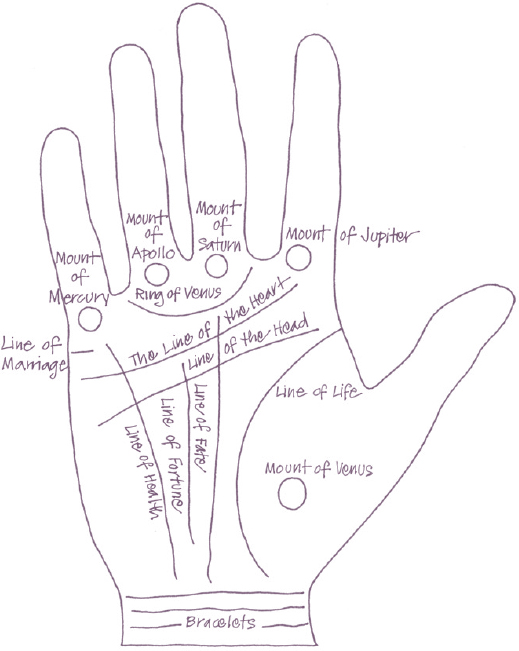
THE HEART LINE
Begin by examining your own Heart line with a magnifying glass or another method so that you can tell where it begins on the hand, how it curves, where it ends, how thick and deep it is, and whether there are any significant breaks.
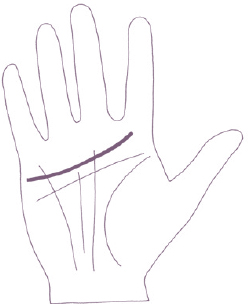
The Heart line, the first to be studied in a reading, reveals information about our emotional state and relationships and anything that is dear to our heart and the potential to grow as a person in every way, what we feel about ourselves, others, and life, with spirit and our inner feelings and the world.
The Heart line often begins around the mount of Mercury at the percussion side of the palm below the little finger above the mount of Luna, running toward the mount of Jupiter, left to right across the palm on the Active hand, ending either close to the base of the first two fingers or, most commonly, between them.
It is the highest line to cross the palm below the fingers, with the Head line beneath it.
If the Heart line is close to the fingers, it can indicate that emotions may be more restrained than in someone with a lower Heart line.
A totally smooth Heart line from beginning to end is rare.
When you learn the meanings of the markings in Chapter 5, you can understand even more of the significance.
If you wish, jump ahead if a particular marking intrigues you, or put your index finger over it and feel whether it is positive, a learning experience, or best left behind.
Different Heart Line Formations
• CLEAR, DEEP, AND LONG LINE: Emotional depths, being in tune with his or her own feelings, concerned for the needs and problems of others.
• CURVING AT THE END: The ability to confidently express innermost needs and feelings.
• STRAIGHT ACROSS THE PALM, NOT CURVING TOWARD THE FINGERS: Easily hurt, needing affection and appreciation.
• COARSE AND GRAINY: Sensuality or a particularly passionate relationship.
• PALE, FLAT, AND BROAD: Sentimentality, but more positively tranquil emotions.
• CONSISTENTLY BROKEN, OR WITH SEVERAL BRANCHES: Feelings are initially intense for people, including friendships, but not long-lasting; a tendency to be discouraged when idealism is replaced by reality.
• CLOSE TO THE BASE OF THE FINGERS, WITH A WIDE SPACE BETWEEN IT AND THE HEAD LINE: A person unresponsive in relationships and cold in interactions.
• TOUCHING THE MOUNT OF JUPITER DIRECTLY, OR AS A BRANCH TO IT:
Altruistic and generous in love and any relationship.
• EXTENDING THROUGH THE JUPITER MOUNT TO THE JUPITER (FIRST) FINGER:
A desire to control relationships and partners; discrimination in choosing partners.
• ENDING AT THE MOUNT OF SATURN: Happiness in love; obstacles in relationships are met by determination to find a solution and patience.
• TOO CLOSE TO THE SATURN (SECOND) FINGER ABOVE THE SATURN MOUNT:
Physical love and outward appearance are significant.
• TOUCHING THE LIFE LINE: Oversensitivity, love can become suffocating or possessive.
• STRAIGHT AND PARALLEL TO THE LIFE LINE: Emotional stability.
• FREQUENT LINES CROSSING THE HEART LINE: Emotional trauma.
• A LONG, STRAIGHT LINE (ENDING BELOW THE INDEX FINGER): An awareness of the feelings of others and the ability to empathize with others.
• UNUSUALLY LONG EDGE TO EDGE OF THE PALM: Dependency on a partner, family, or close friends.
• A FAINT LINE: Being dominated or bullied or with a very delicate energy field.
• SHORT, STRAIGHT LINE (ENDING BETWEEN THE MIDDLE AND INDEX FINGERS):
Unromantic, demonstrating love through actions, not words.
• A LONG, CURVED LINE (ARCHING TO REACH THE BASE OF THE MIDDLE FINGER): Tendency to follow desires, romantic impulses, and passions.
• A LINE SPLIT IN TWO: Putting the needs of others first.
• SIMILARITY TO A PARTNER’S: This indicates compatibility.
• SPLITTING INTO THREE TO FORM A TRIDENT: Luck in love and life.
• ENDING BETWEEN FIRST AND SECOND FINGERS: Balance in relationships.
• A PRONOUNCED GIRDLE OF VENUS (SEE DIAGRAM IN THIS CHAPTER AND CHAPTER 4), RELATED CLOSELY TO THE HEART LINE: A need for physical intimacy and, if deep, great sensuality.
• A CONSISTENTLY CHAINED LINE: Maybe more than one love relationship going on at the same time, conflicting emotions, and sometimes past life/karmic unfinished business.
THE HEAD LINE
This is the line running across the palm from the side of the hand between the thumb and the forefinger to the mount of the Moon area of the hand or above toward the little finger side, right to left in the Active Hand, below the Heart line.
Its links with other mounts and lines are especially influential, and it is the second line to be studied in a palm reading.
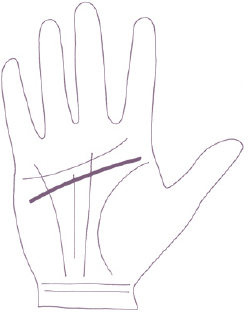
Remember, the Heart and Head lines start from opposite sides of the hand.
The Head line can have several starting points, for example from the Life line, whose energies thereby reinforce natural determination in the Head line.
Another beginning is at the mount of Jupiter, which can indicate great authority and wisdom—but, on the negative side, egoism.
The Head line expresses how our thoughts and intellect are manifest in our lives; our logic and rational dealings with the world and those around us; and what we think, as opposed to what we feel about ourselves, our outer persona as revealed to the world.
Look especially at any parallels between the Heart and Head lines: for example, if one fades or is crossed with lines as the other becomes strong.
Different Head Line Formations
If the Heart and Head lines are very close, there can be a conflict between the Heart and Head.
If the Heart line is joined to the Head line, relationships may suffer because of work or outside interests being a priority.
• IF THE HEAD LINE TOUCHES THE LIFE LINE AT THE START: Indicates a cautious person who thinks before s/he acts. When there is a gap between the start of the Head line and Life line, the person will be independent and impulsive; and the larger the gap, the more outspoken, impulsive, and independent s/he will be.
• IF THE LINE IS HIGH AND IT DOES NOT BEGIN OR MEET WITH THE LIFE LINE:
Independence from birth, own ideas, may be a rift between person and immediate family; the person is happier with facts and figures than people.
• IF THE LINE IS CLOSE TO THE THUMB OR JOINS THE LIFE LINE FOR A LENGTH:
A cautious, conservative thinker and a family-minded person who may have a family-based or home business.
• BEGINNING BELOW THE LIFE LINE: Shyness from childhood, perhaps an absent parent, over-defensiveness at work and socially due to hidden insecurity.
• A LONG, WELL-FORMED LINE: Justice and idealism.
• A LONG LINE ARCHING SLIGHTLY TOWARD MOUNT LUNA WITHOUT DIPPING DOWN SUDDENLY: Many interests and an openness to learning.
• A WAVY HEAD LINE: Influenced by different people and finding it hard to make decisions.
• A DEEP LINE: Concentration and memorization will be easy.
• A STRONGLY MARKED LINE: Intelligence and imagination, logic and determination, but, less positively, also a touch of ruthlessness.
• A SHORT LINE (ENDING NEAR THE CENTER OF THE PALM): A fast thinker and with unlimited capacity to learn, but can be impatient with traditional learning.
• A PALE, SHORT LINE: Timidity and diffidence in career or social dealings.
• A FAINT LINE: Intellectual and reasoning ability is not being fully used.
• A STRAIGHT LINE: A logical, practical down-to-earth approach and, if extending to the little finger, a tendency toward analyzing every situation and sometimes overthinking.
• LINE CURVING TOWARD THE WRIST: A creative, imaginative approach to life, good at finding alternative solutions.
• A REALLY LARGE CURVE: Gifts in creative arts (check with the Apollo Sun line in Chapter 4), but also liberal with the truth.
• A FORK AT THE END OF THE HEAD LINE: The Writer’s fork, the mark of the writer and communicator.
• AN UPWARD BRANCH ANYWHERE ON THE LINE: Skills in making money and a good gambler.
• A BRANCH CONNECTING THE HEAD AND HEART LINES: Confusion if emotions override common sense.
• A DISTINCTIVE BEND AT THE END: Strong material needs.
• A SPLIT LINE: The ability to see both sides of a question—or sit on the fence.
• BROKEN LINES: Many options that have not been followed through; changes should not be made out of restlessness or boredom.
• STARTING ON MOUNT JUPITER: Influenced by ambitions; if well developed, a good teacher or instructor.
• CONTINUING IN A STRAIGHT LINE RIGHT ACROSS THE PALM: A practical approach, good business sense and persistence.
• DIPPING DEEPLY TOWARD THE MOUNT OF THE MOON: Overindulgence; and if the mount is well developed, sign of a dreamer.
• A DOUBLE HEAD LINE: Either genius or double-dealing, sometimes both.
Timing
There are many conflicting opinions about timing events on the Active hand, and the simplest method is to divide the Head and Heart lines in two.
The first half of the Head line on the Active hand starts from the edge of the hand and ends under the Saturn finger, and represents ages 0 to 40.
The second half shows 40 to the end of life, which is never defined.
Alternatively, you can use the Fate or Destiny line if this is clearly marked on the active palm.
By age 35, the Fate or Destiny line reaches the Head line.
By 49, the Destiny line reaches the Heart line, and the rest marks out the remainder of life.
The length of life is not indicated by any line or measurement, and I do not believe that any clairvoyant or medium can know this date of death, for themselves or others—or indeed should.
Many heartaches are caused by irresponsible people predicting the deaths of others to satisfy their own egos.
Remember, though, if matters are resolved and an event was some years ago, it may at least have been partly erased; so if you are trying to predict the future, the most useful function of palmistry, look when new lines either of independence or new love become smooth and deep—and may indeed form parallel or overlapping lines.
WORKING WITH THE HEART AND HEAD LINES
Once you have plotted your own lines on your blank diagram, try to study at least ten other people’s Heart and Head lines; people you do not know very well, perhaps in the workplace or socially, and if possible try to make some contact with the palm, so you can add what you feel.
This is not as hard as it may at first seem.
If you are ingenious, there will be many occasions when someone will have at least one of their palms in full view for a minute or two.
If you can see both hands, so much the better.
Scribble it down and later copy the information on a blank sheet.
Then with the lists above, check what characteristics you found.
If you can ask casual questions, you can determine how accurate your observations are.
But remember, people won’t always tell the truth about their lives.
Next, study the Heart and then the Head line of the person whose hands you held and felt in detail in the Introduction, and compare the new information that you can add to the original palm diagrams and your intuitive reading.
Practice drawing some of the Heart/Head combinations from the above list and create imaginary people based on the Heart and Head lines.
Be alert to Heart and Head line combinations everywhere, even fleeting glances of the hands of people you encounter at social events, traveling, or in your working day.
You will soon see patterns emerging and be able to make fast assessments of hands.
THE HEART AND HEAD LINES AND TEENAGERS
You may find in teenagers quite wavy Heart Lines with frequent breaks as teenage romances ebb and flow.
Head Lines may, sometimes in correspondingly similar areas, have lots of stops and starts and varying thickness and intensity, as career choices and enthusiasms wax and wane.
Let’s take, for example, sixteen-year old Cleo.
For about nine months, Cleo consistently revealed a pulsating deep and intense Heart Line because love was her current main interest.
However, her Head line became correspondingly relatively pale approximately nine months ago as her early career dreams took second place to romance.
Her previous boyfriend, with whom she broke up three months ago, had a very deep straight Head Line, but a wavy paler Heart Line, as he was intensely driven by his parents to give up Cleo and focus on career.
In contrast, Cleo’s new boyfriend’s Heart Line mirrors hers, and even within six months of getting together their corresponding Head Lines are getting similarly stronger as they plan to go to college together next year.
In the next chapter, we will study the Life line and the Fate or Destiny line.